

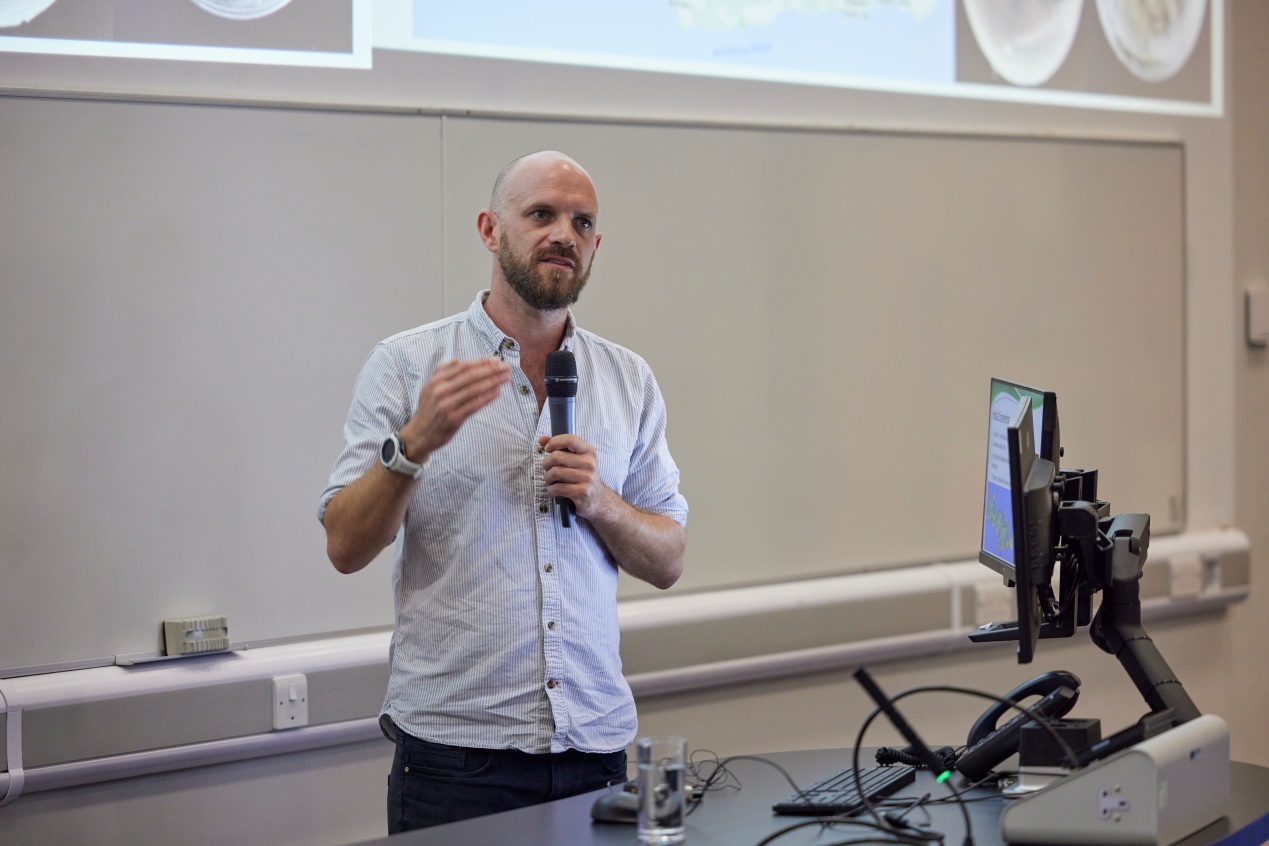
The talk presented by Dr. Wood focused on the discovery and screening of novel bacterial isolates for mosquitocidal activity against Culex pipiens molestus larvae, building on earlier poster work with minor updates. From a large environmental library generated in Crete, over 700 live isolates were screened, of which 108 caused 100% mortality within seven days and 37 achieved this within three days. These leading isolates were further evaluated using sonicated and solvent-extracted preparations, identifying several highly active strains (notably OTN1-C11, OTN72-C2, and OTN78-C5) that maintained strong efficacy, frequently achieving near-complete mortality within 24–48 hours. Extraction assays confirmed that both extracellular non-polar compounds (n-hexane fractions) and intracellular polar compounds (ethyl acetate extracts) contribute to larvicidal activity, with clear variation among isolates in whether active compounds are secreted or cell-associated. Distinct differences were also observed in the balance, or absence, of polar and non-polar compound blends underpinning insecticidal effects across isolates.
The program of the Symposium can be downloaded here.