

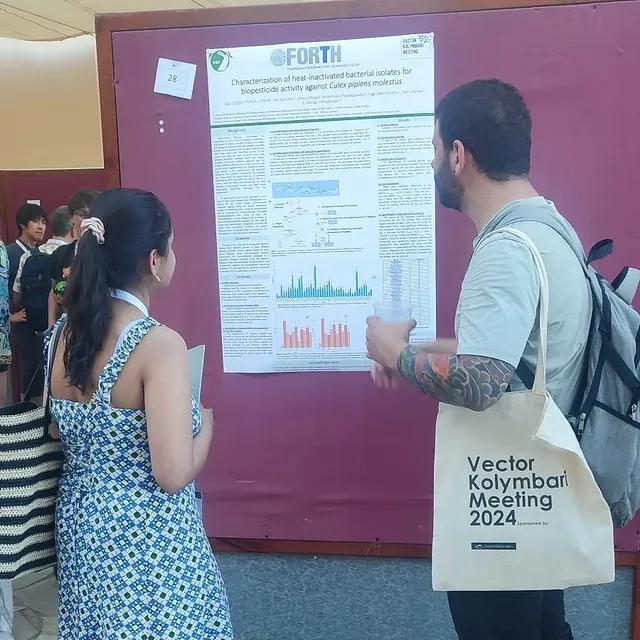
The poster presented by the post-doctoral researcher Juan Silva (Characterization of bacterial isolates as biopesticides using heat-inactivation preparations in Culex pipiens molestus.) aimed at screening bacterial isolates for their potential against mosquito larvae. From a total of 1,709 isolates obtained from environmental samples, 750 were screened as live preparations against larvae of Culex pipiens molestus. From these, 109 isolates caused 100% larval mortality within seven days, with 37 isolates achieving it within three days. Taxonomic identification based on 16S rRNA sequencing revealed that the 109 isolates belonged to 37 bacterial genera, with Pseudomonas being the most abundant. Subsequent bioassays used heat-inactivated preparations to identify isolates producing heat-stable compounds. Bioassays with the 37 isolates revealed 5 isolates resulting in higher larval mortality. Bioassays to identify the source of toxins suggested that insecticidal activity was associated to cell components rather than secreted metabolites in the culture medium.
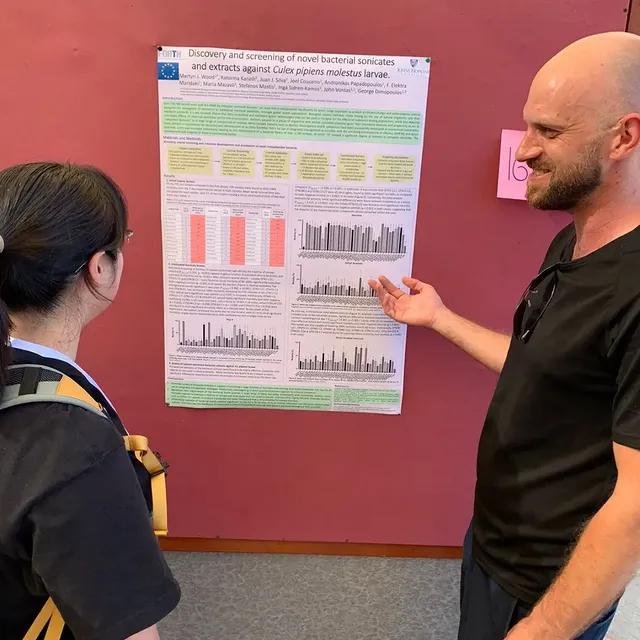
The poster presented by Dr. Martyn J. Wood focused on the discovery and screening of novel bacterial isolates for mosquitocidal activity against Culex pipiens molestus larvae. From a large environmental library generated in Crete, >700 live isolates were screened, of which 108 caused 100% mortality within seven days and 37 achieved this within three days. These 37 isolates were further evaluated using sonicated and solvent-extracted preparations, revealing several highly active strains (notably OTN1-C11, OTN72-C2, and OTN78-C5) that maintained strong efficacy, often achieving near-complete mortality within 24–48 hours. Extraction assays indicated that both extracellular non-polar compounds (in n-hexane fractions) and intracellular polar compounds (in ethyl acetate extracts) contribute to larvicidal activity, with different isolates seemingly producing the insecticidal actives in different locations; cellular components or within the supernatant only. Furthermore, clear differentiation between isolates could be seen in terms of the blend of polar and non-polar compounds; or lack of duality; causing insecticidal activity.
Link to poster here.